Repair Your Skin Barrier
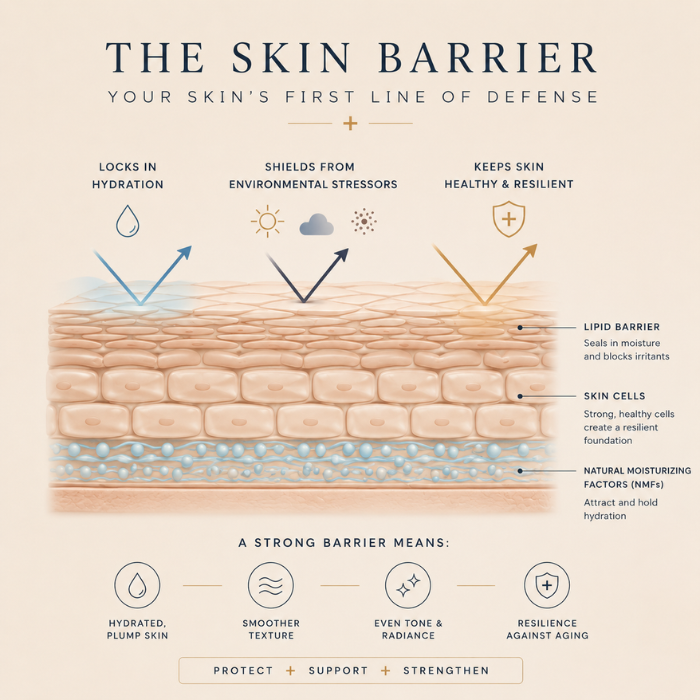
So you've identified the signs — your barrier is compromised. Now what? Repair is very possible, but it requires a different approach than most people expect. Here's how to do it right.
THE MINDSET SHIFT
Repair is subtraction, not addition
The instinct when skin is struggling is to reach for more; more serums, more treatments, more products. With a damaged barrier, that instinct will work against you. The first and most important step in repair is simplifying.
A compromised barrier is hyperpermeable meaning it absorbs more than it should. This is why even normally well-tolerated ingredients can penetrate too deeply and cause irritation. Adding actives at this stage is like pouring water into a cracked cup. The goal right now isn't to treat your skin concerns. The goal is to stabilize the barrier so your skin can treat itself.
Most barrier damage heals on its own if you stop doing the things that caused it. The skin's natural repair cycle runs on roughly a two-to-four week timeline. Your job is to get out of the way and support that process.
THE REPAIR PROTOCOL
Six steps that actually move the needle
These aren't complicated, but they do require consistency — and some patience. Think of this as a reset, not a quick fix.
The repair protocol
Six steps that actually move the needle
These aren't complicated, but they do require consistency — and some patience. Think of this as a reset, not a quick fix.
Switch to a gentle, non-foaming cleanser
Foaming cleansers strip the skin's natural oils along with dirt and makeup. During repair, use a cream or micellar cleanser that cleans without disrupting the lipid layer. Lukewarm water only — hot water accelerates moisture loss.
Pause all actives temporarily
Retinoids, acids (AHAs, BHAs), vitamin C, and exfoliants all increase cell turnover — which is great for healthy skin, but counterproductive when the barrier is already stressed. A two-week pause is typically enough. Reintroduce one at a time, slowly.
Moisturize immediately after washing
Apply moisturizer within 60 seconds of cleansing, while skin is still slightly damp. This locks in water before transepidermal water loss (TEWL) can occur. For significantly damaged skin, consider applying a second layer at night.
Choose a moisturizer that replenishes ceramides
Not all moisturizers repair the barrier — many simply hydrate the surface. Look for formulas that contain ceramides, cholesterol, and fatty acids in the right ratio. These are the actual building blocks the barrier needs to rebuild its lipid matrix.
Wear SPF every single day
UV exposure degrades the lipid layer and slows repair. A compromised barrier is even more vulnerable to UV damage than healthy skin. Use a mineral or physical SPF if chemical filters are currently irritating — zinc oxide is well tolerated on sensitive skin.
Address your environment
Low humidity is one of the most underrated contributors to barrier damage. If you live in a dry climate or spend a lot of time in air conditioning, a humidifier in your bedroom can meaningfully reduce overnight TEWL and speed up repair.
WHAT TO AVOID
Things that slow the repair process
Repair stalls when the source of damage is still active. These are the most common culprits we see keeping patients stuck in a cycle of sensitivity.
The repair protocol
Six steps that actually move the needle
These aren't complicated, but they do require consistency — and some patience. Think of this as a reset, not a quick fix.
Switch to a gentle, non-foaming cleanser
Foaming cleansers strip the skin's natural oils along with dirt and makeup. During repair, use a cream or micellar cleanser that cleans without disrupting the lipid layer. Lukewarm water only — hot water accelerates moisture loss.
Pause all actives temporarily
Retinoids, acids (AHAs, BHAs), vitamin C, and exfoliants all increase cell turnover — which is great for healthy skin, but counterproductive when the barrier is already stressed. A two-week pause is typically enough. Reintroduce one at a time, slowly.
Moisturize immediately after washing
Apply moisturizer within 60 seconds of cleansing, while skin is still slightly damp. This locks in water before transepidermal water loss (TEWL) can occur. For significantly damaged skin, consider applying a second layer at night.
Choose a moisturizer that replenishes ceramides
Not all moisturizers repair the barrier — many simply hydrate the surface. Look for formulas that contain ceramides, cholesterol, and fatty acids in the right ratio. These are the actual building blocks the barrier needs to rebuild its lipid matrix.
Wear SPF every single day
UV exposure degrades the lipid layer and slows repair. A compromised barrier is even more vulnerable to UV damage than healthy skin. Use a mineral or physical SPF if chemical filters are currently irritating — zinc oxide is well tolerated on sensitive skin.
Address your environment
Low humidity is one of the most underrated contributors to barrier damage. If you live in a dry climate or spend a lot of time in air conditioning, a humidifier in your bedroom can meaningfully reduce overnight TEWL and speed up repair.
WHAT TO EXPECT
The repair timeline
Barrier repair isn't instant, and the timeline varies based on how long the damage has been present and how consistently the repair protocol is followed. Here's a realistic picture of what most patients experience.
What to expect
The repair timeline
Barrier repair isn't instant, and the timeline varies based on how long the damage has been present and how consistently the repair protocol is followed. Here's a realistic picture of what most patients experience.
Days 1–3
The calm-down phase
Redness and stinging begin to subside as the barrier is no longer being actively provoked. Skin may still feel tight or sensitive which is normal. Resist the urge to reintroduce products.
Week 1–2
Early stabilization
Tightness and flakiness improve as the lipid layer starts to rebuild. Skin should start to feel more comfortable and less reactive. Some patients see meaningful improvement by the end of week two.
Week 2–4
Active repair
The barrier is rebuilding in earnest. Redness fades, texture smooths, and products that were previously irritating become tolerable again. This is when you can begin carefully reintroducing actives but only one at a time, every few days.
Week 4+
Restored function
For most patients, the barrier is substantially recovered by week four. Chronic or severe cases may take longer. The goal from here is maintenance to protect the barrier while layering back in the treatments that support your broader skin goals.
