Explore Free Resources
Start here.
Practical tools to help you understand what your skin and hair may be telling you.
Featured Products
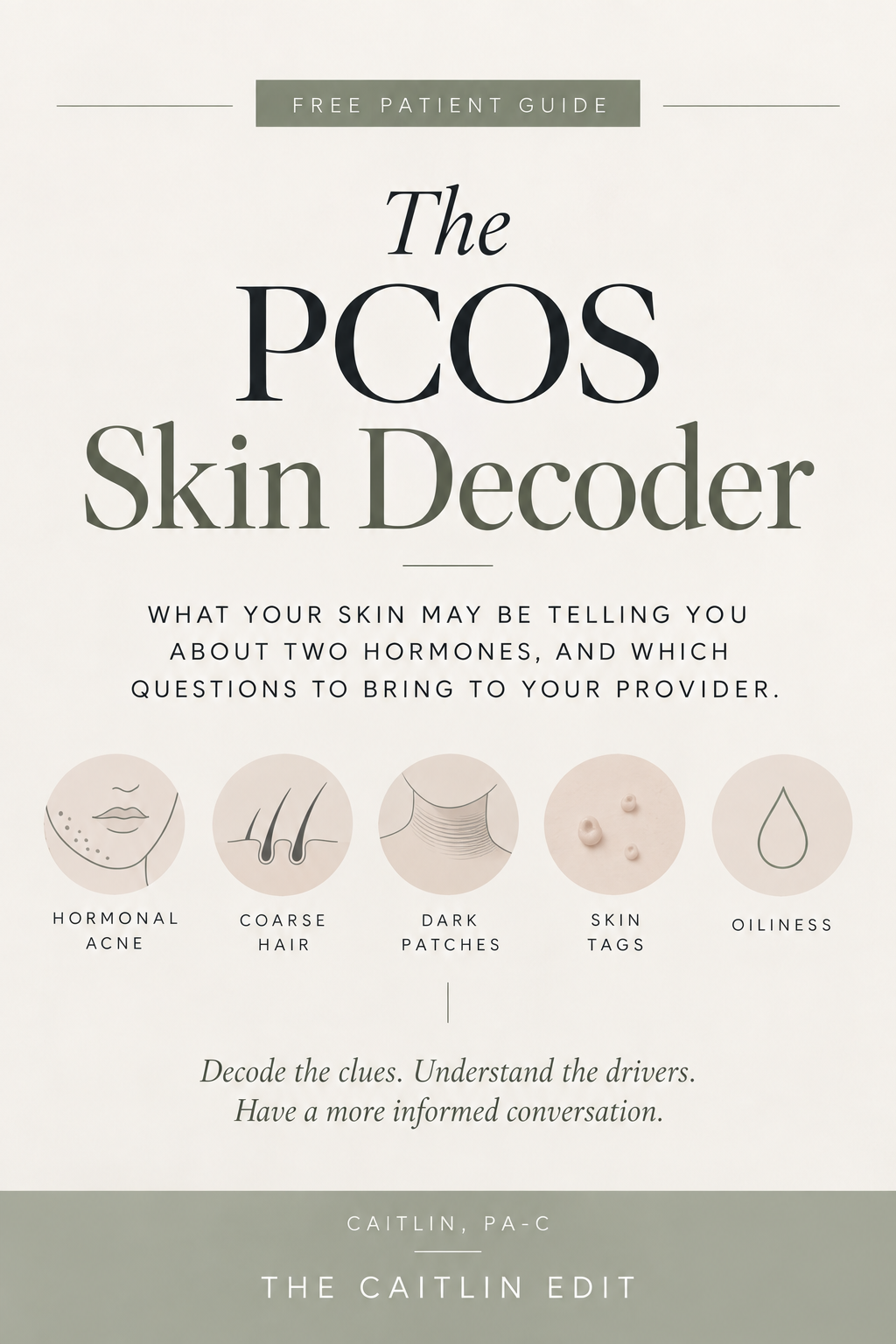
The PCOS Skin Decoder is a free guide to help you understand what common PCOS-related skin changes may be telling you.
Learn how to recognize patterns in hormonal acne, facial hair, dark patches, skin tags, and persistent oiliness, understand whether androgen or metabolic factors may be contributing, and know what questions are worth bringing to your provider.
Decode the signs. Understand the possible driver. Know what to ask next.
FREE DIGITAL GUIDE
Instant download. For educational purposes only and not intended to replace individualized medical advice, diagnosis, or treatment.
Losing weight on a GLP-1 but noticing more hair in the shower? There’s a reason, and it may not be the medication itself.
Hair shedding can occur during GLP-1–assisted weight loss, particularly when rapid weight loss, reduced protein intake, and nutrient deficiencies trigger telogen effluvium, a temporary form of excessive shedding.
This free guide breaks down why GLP-1–related hair loss happens, when shedding typically starts, how long it may last, and what your hair actually needs to recover.
Inside, you’ll learn:
The typical GLP-1 hair shedding + regrowth timeline
Why protein and adequate nutrition matter for the hair follicle
Labs worth discussing with your healthcare provider
What I recommend focusing on (and what I skip)
When hair loss may be more than simple telogen effluvium
Practical steps to support healthier regrowth while continuing your weight-loss journey
No complicated supplement routine. No panic-buying hair vitamins. Just a practical, dermatology-informed approach to understanding what may be happening and what deserves your attention.
The Hair Loss Decoder is a free 8-page guide that helps you identify which of the five hair loss patterns is yours, and exactly what to do first. Written by a board-certified dermatology PA-C.
Most people treat hair loss backwards: buy the supplement first, ask questions later. But shedding after a stressful season, a widening part line, and thinning at your edges are three completely different problems with three completely different fixes. The Decoder walks you through the five most common patterns I see in practice, what each one looks like, what triggers it, and the first steps actually worth your time.
Inside the guide:
A quick-reference chart comparing all five patterns at a glance
What each pattern looks like, what drives it, and your first steps
The clinical pearls I share with my own patients, including the one lab question almost everyone forgets to ask
A 3-question self-check to land on your pattern, plus the red flags that mean see a provider now
This guide is education, not medical advice, and does not replace evaluation by your own provider.
The PCOS Skin Decoder is a free guide to help you understand what common PCOS-related skin changes may be telling you.
Learn how to recognize patterns in hormonal acne, facial hair, dark patches, skin tags, and persistent oiliness, understand whether androgen or metabolic factors may be contributing, and know what questions are worth bringing to your provider.
Decode the signs. Understand the possible driver. Know what to ask next.
FREE DIGITAL GUIDE
Instant download. For educational purposes only and not intended to replace individualized medical advice, diagnosis, or treatment.
A free symptom checklist to help you understand what may actually be behind your hair loss.
If you have PCOS and you're experiencing hair loss, it's easy to assume your hormones are the cause. But PCOS is only one piece of the puzzle.
Inside this free guide, you'll learn how to:
Tell the difference between thinning and shedding
Recognize signs of PCOS-related pattern hair loss
Identify the classic pattern and triggers of telogen effluvium
Spot clues that thyroid, iron, or nutritional factors may be contributing
Understand when more than one type of hair loss may be happening at once
Know which hair-loss strategies are worth your energy and which you can probably skip
Recognize when your hair loss deserves a closer look from a dermatology provider
You'll also get simple symptom checklists to help you compare your own experience with the most common patterns.
Because having PCOS doesn't automatically mean PCOS is causing your hair loss.
The goal is to stop guessing, identify the pattern, and have a clearer idea of what to discuss with your healthcare provider next.
Instant download. For educational purposes only and not intended to replace individualized medical advice, diagnosis, or treatment.
Losing weight on a GLP-1 but noticing more hair in the shower? There’s a reason, and it may not be the medication itself.
Hair shedding can occur during GLP-1–assisted weight loss, particularly when rapid weight loss, reduced protein intake, and nutrient deficiencies trigger telogen effluvium, a temporary form of excessive shedding.
This free guide breaks down why GLP-1–related hair loss happens, when shedding typically starts, how long it may last, and what your hair actually needs to recover.
Inside, you’ll learn:
The typical GLP-1 hair shedding + regrowth timeline
Why protein and adequate nutrition matter for the hair follicle
Labs worth discussing with your healthcare provider
What I recommend focusing on (and what I skip)
When hair loss may be more than simple telogen effluvium
Practical steps to support healthier regrowth while continuing your weight-loss journey
No complicated supplement routine. No panic-buying hair vitamins. Just a practical, dermatology-informed approach to understanding what may be happening and what deserves your attention.
The Hair Loss Decoder is a free 8-page guide that helps you identify which of the five hair loss patterns is yours, and exactly what to do first. Written by a board-certified dermatology PA-C.
Most people treat hair loss backwards: buy the supplement first, ask questions later. But shedding after a stressful season, a widening part line, and thinning at your edges are three completely different problems with three completely different fixes. The Decoder walks you through the five most common patterns I see in practice, what each one looks like, what triggers it, and the first steps actually worth your time.
Inside the guide:
A quick-reference chart comparing all five patterns at a glance
What each pattern looks like, what drives it, and your first steps
The clinical pearls I share with my own patients, including the one lab question almost everyone forgets to ask
A 3-question self-check to land on your pattern, plus the red flags that mean see a provider now
This guide is education, not medical advice, and does not replace evaluation by your own provider.